
Barcelona is a city full of history, sea light, narrow medieval streets and elegant avenues, but few names are as closely connected to its identity as Antoni Gaudí. His architecture is one of the main reasons travelers come to the city, but Gaudí was much more than the creator of famous monuments. He was an architect, craftsman, observer of nature and visionary who changed the way Barcelona looks and feels.
If you are planning a Gaudi tour Barcelona experience, it helps to understand the man behind the buildings. Gaudí’s work is not only about colorful tiles or unusual shapes. It is about symbolism, structure, faith, nature, Catalan culture and the transformation of Barcelona during one of its most creative periods.
This guide will help you understand Gaudi Barcelona architecture, the ideas behind his work, and how to enjoy a meaningful gaudi walking tour Barcelona without simply moving from one landmark to another.
Who Was Antoni Gaudí?
Antoni Gaudí was born in Catalonia in 1852 and became the most famous architect of Catalan Modernism. This artistic movement developed during a time when Barcelona was expanding, becoming wealthier and searching for a modern cultural identity.
Unlike many architects of his time, Gaudí did not see buildings as simple structures. He imagined them as complete living organisms. Every door, staircase, window, rooftop, column and decorative detail had a purpose.
His work combines architecture, engineering, religion, craftsmanship and nature. That is why Gaudi buildings Barcelona are so different from anything else in the city. They are not just beautiful; they are full of meaning.
Gaudí and Nature: The Key to His Architecture
To understand Gaudí, you need to look at nature. He studied trees, shells, bones, caves, mountains, animals and the movement of light. Instead of copying nature in a decorative way, he tried to understand how it worked.
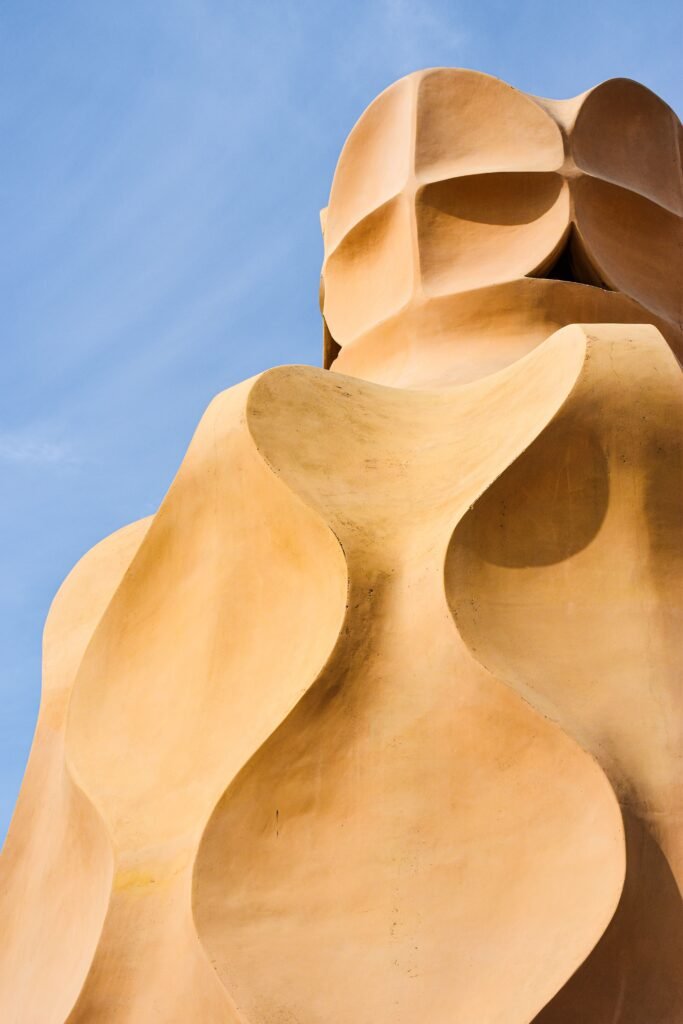
This is why many Barcelona Gaudi buildings have curved lines, organic shapes and unusual structures. Columns can look like tree trunks. Roofs can resemble waves or dragon scales. Windows and courtyards are designed to bring air and light into the building naturally.
For Gaudí, nature was not an ornament. It was a teacher.
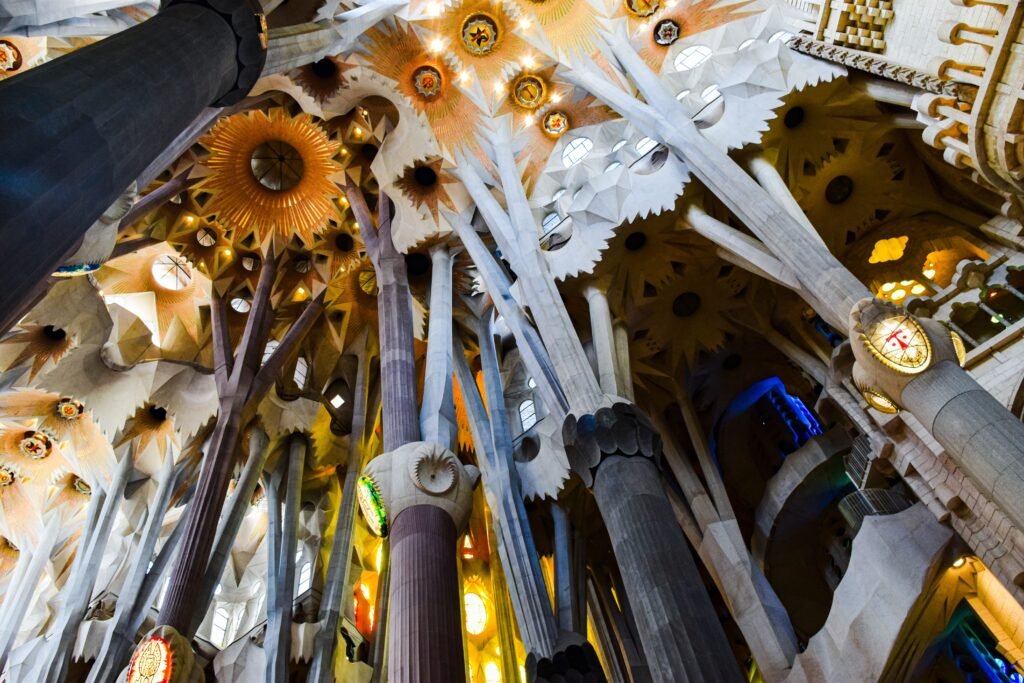
This idea can be seen clearly at the Sagrada Família, where the interior feels like a stone forest, but also in Casa Batlló, La Pedrera, Park Güell and Palau Güell. Each site shows a different stage of his imagination and technical evolution.
Gaudí and Barcelona: Why His Work Belongs Here
Gaudí’s work could only have happened in Barcelona. At the end of the 19th century, the city was changing quickly. The medieval walls had been demolished, the Eixample district was growing, and wealthy industrial families were commissioning bold new buildings.
This was the perfect environment for Catalan Modernism. Architects, artists and craftspeople were creating a new visual language for the city. Gaudí became one of its most original voices.
A Barcelona Gaudi tour is also a journey through this moment in history. It shows how Barcelona moved from a compact old city into a modern European capital, while still keeping a strong Catalan identity.
When you walk through the Eixample and see buildings such as Casa Batlló and La Pedrera, you are not just looking at architecture. You are seeing the ambition, taste and social changes of a city in transformation.
The Spiritual Side of Gaudí
Gaudí’s later life was deeply marked by religion, and this is essential to understanding the Sagrada Família. Although many people casually call it the Gaudi cathedral Barcelona, its correct name is the Basilica of the Sagrada Família.
For Gaudí, this project became much more than a church. It was a symbolic world built in stone, where façades, towers, sculptures, light and geometry all carried meaning. The Nativity Façade celebrates life and creation, while the Passion Façade reflects suffering and sacrifice.
Inside, the columns branch like trees and the colored glass changes the atmosphere throughout the day. The building is designed to be read slowly, almost like a visual book.
This is one of the reasons a guided visit can be so valuable. Without context, the Sagrada Família is impressive. With context, it becomes one of the clearest expressions of Gaudí’s mind.
Gaudí’s Use of Craftsmanship
One of the most fascinating things about Gaudí is that he worked closely with artisans. Ironworkers, ceramicists, carpenters, glassmakers and stone carvers all played a role in his buildings.
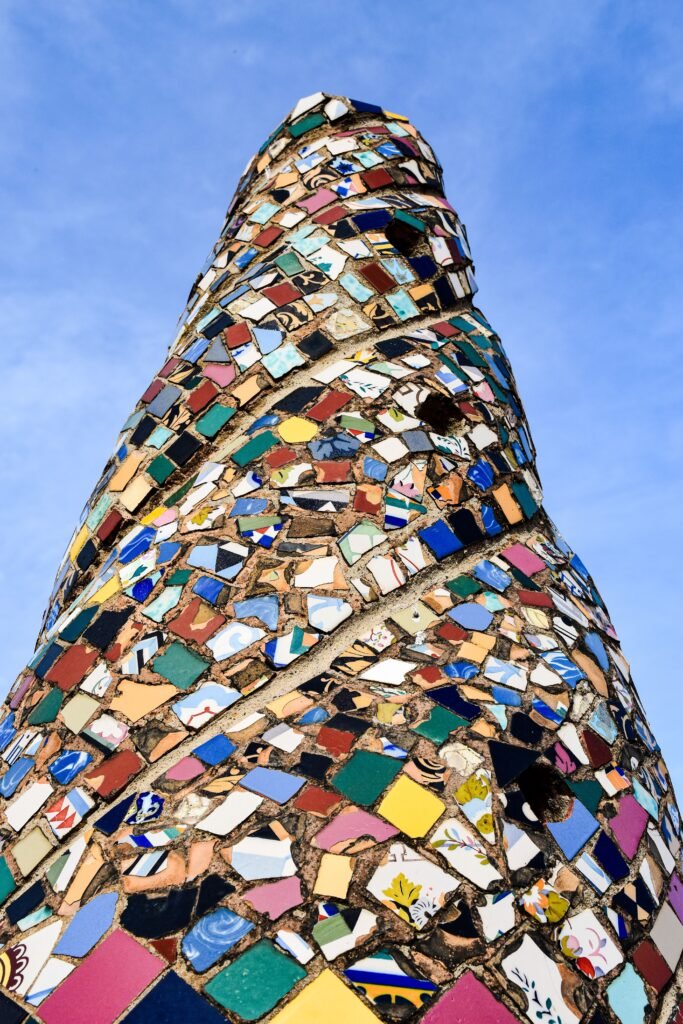
This is why Gaudi art Barcelona feels so complete. Architecture and decoration are not separate. A balcony, a door handle or a chimney can be as carefully designed as the façade itself.
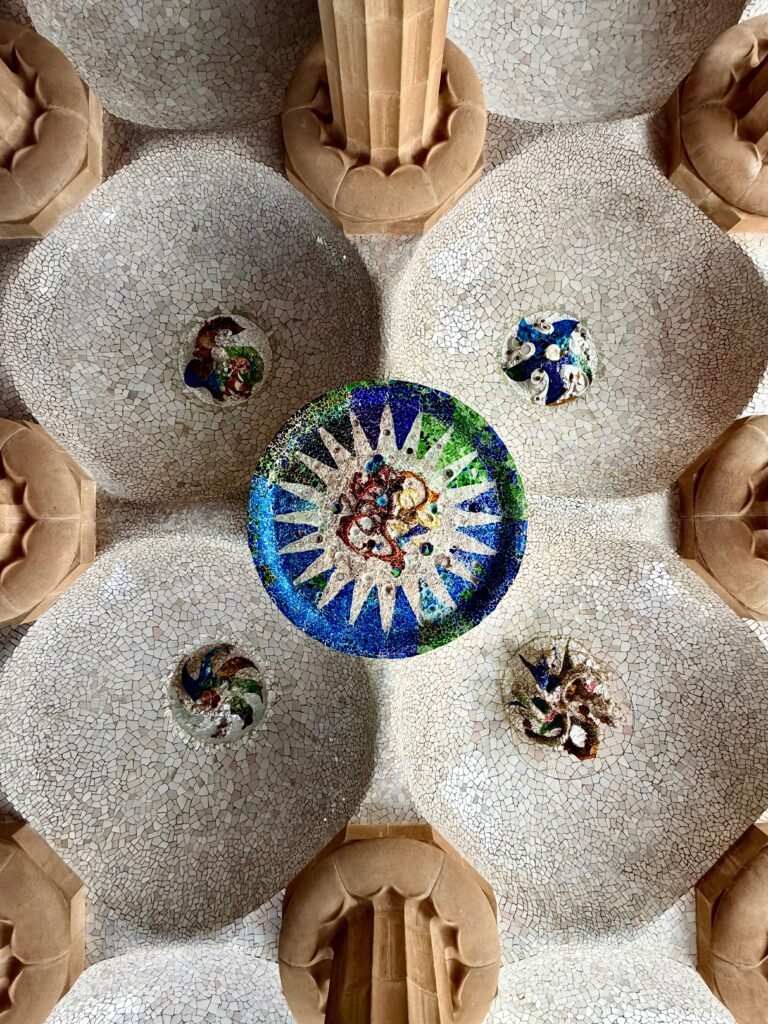
The famous Gaudi tiles Barcelona style, especially the broken ceramic mosaic known as trencadís, is a perfect example. It was colorful, practical and creative. Broken pieces of ceramic were reused to cover curved surfaces, creating one of the most recognizable visual languages in Barcelona.
This attention to craft is also why Gaudí’s buildings feel handmade, even when they are technically complex.
Gaudí’s Main Places in Barcelona
Although this guide is more about understanding Gaudí than listing monuments, there are several essential Gaudi sites in Barcelona that help tell his story.
The Sagrada Família is the great project of his life and the best place to understand his spiritual and symbolic universe.
Park Güell, often searched as Barcelona Gaudi Park, shows his playful side and his ability to combine architecture with landscape.
Casa Batlló reveals his imagination through color, light and marine-inspired forms.
La Pedrera, also known as Casa Milà, is one of the most innovative Gaudi houses Barcelona visitors can explore, especially because of its structure, courtyards and rooftop.
Palau Güell shows an earlier Gaudí, already experimenting with space, light and symbolism.
Together, these places form the heart of any Gaudi walking tour Barcelona, although not all of them are close enough to visit comfortably on foot in one single route.
How to Plan a Gaudí Walking Tour in Barcelona
A good Gaudi walking tour Barcelona should not feel like a rushed checklist. Gaudí’s buildings deserve time, attention and interpretation.
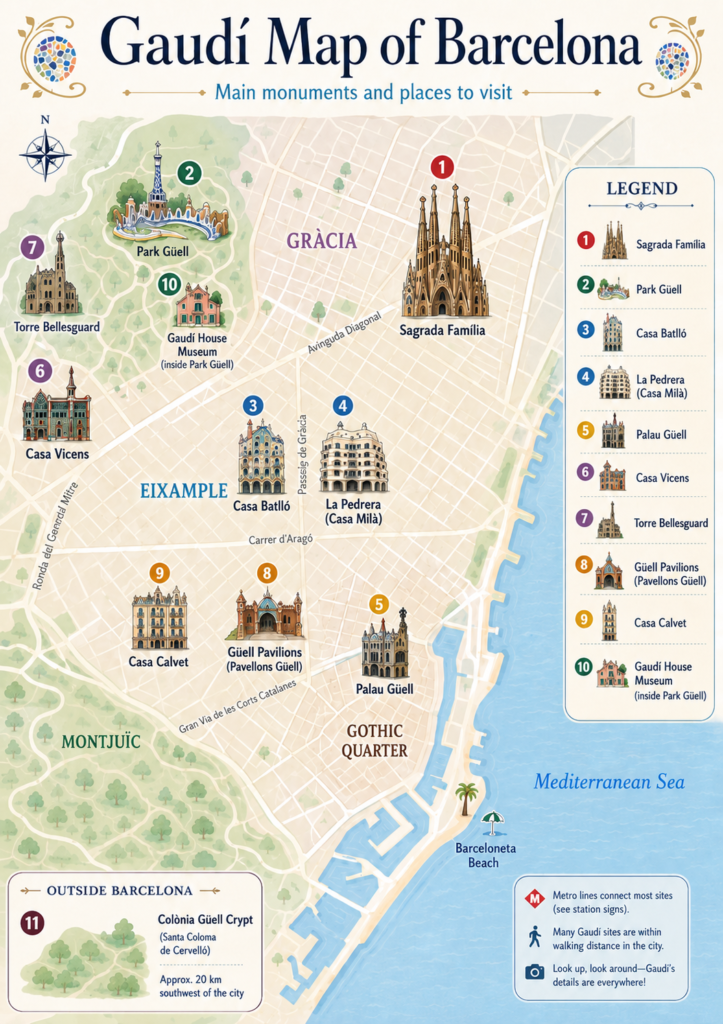
A practical route can begin in the Eixample, where Casa Batlló and La Pedrera are close to each other. This area is perfect for understanding modern Barcelona, elegant avenues and the rise of Catalan Modernism.
From there, you can continue toward the Sagrada Família by metro, taxi or a longer walk if you enjoy exploring the city. Park Güell is farther north, so it is usually better to visit separately or as part of a carefully planned route.
Using a Gaudi buildings Barcelona map can help, but the real value is not only knowing where the buildings are. It is understanding how they connect: early experiments, private commissions, public spaces, religious symbolism and Gaudí’s final years.
Why a Private Gaudí Tour Can Make the Experience Better
A private Gaudi tour Barcelona can be especially helpful if you want to go beyond the surface. Gaudí’s work is full of symbols and technical details that are easy to miss when visiting alone.
A local guide can explain why a façade looks the way it does, how Gaudí used natural forms, what certain symbols mean, and how each building fits into Barcelona’s history.
A guided experience also helps with timing and route planning. Some Gaudi attractions Barcelona require advance tickets, and distances between sites can be confusing for first-time visitors. A well-planned tour makes the day smoother and more meaningful.
For travelers interested in architecture, culture or local history, the best Gaudi tour Barcelona is one that balances famous monuments with storytelling, context and time to observe the details.
Gaudí Beyond the Famous Monuments
Gaudí’s influence goes beyond the main tourist sites. His work shaped how people imagine Barcelona: colorful, creative, symbolic and slightly surreal.
You can see his legacy in the city’s souvenirs, design shops, postcards and visual identity. Many Gaudi Barcelona souvenirs are inspired by mosaics, dragons, chimneys, rooftops and organic patterns.
But Gaudí is more than an image. His work represents a way of thinking: architecture should be beautiful, useful, symbolic and connected to nature.
That is why his buildings still feel modern today. They were created over a century ago, but they continue to surprise visitors because they do not follow ordinary rules.
Gaudí’s Final Years and Legacy
Gaudí dedicated the last part of his life almost entirely to the Sagrada Família. His lifestyle became increasingly simple, and he was so absorbed in his work that he gradually stepped away from public life.
His death in 1926 was tragic. He was hit by a tram in Barcelona and, because of his modest appearance, was not immediately recognized. Today, he is remembered as one of the most original architects in history and a defining figure of Barcelona.
His legacy is not limited to one building. The Antoni Gaudi buildings Barcelona visitors admire today form a creative map of the city: from private homes to public spaces, from rooftops to religious symbolism, from craft details to visionary engineering.
Final Thoughts
Gaudí is one of the best ways to understand Barcelona. His work brings together nature, faith, Catalan identity, craftsmanship, imagination and the city’s modern history.
Whether you are planning a Gaudi tour Barcelona, visiting the Sagrada Família, exploring Park Güell, walking through the Eixample or looking for a deeper Barcelona Gaudi tour, take your time. Gaudí’s architecture rewards slow looking.
The more you understand his ideas, the more Barcelona opens up. His buildings are not just places to photograph. They are stories written in stone, ceramic, light and color.